
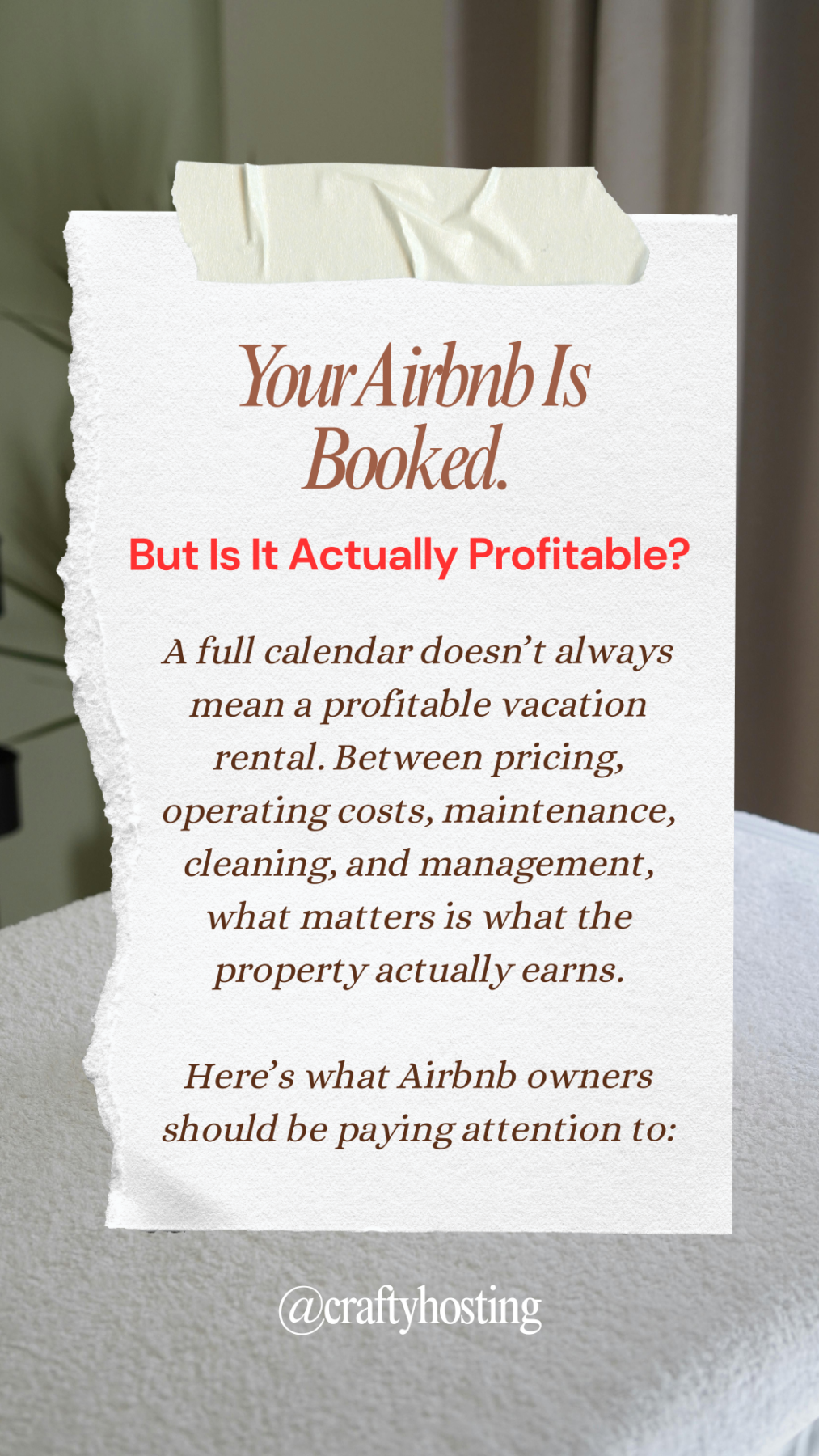
A full Airbnb calendar looks great.
Reservations are coming in. Guests are checking in and out. Revenue is hitting the bank account. On the surface, the property appears to be performing exactly as it should.
But there is one question every vacation rental owner should be asking:
Is the property actually making money?
Because occupancy and profitability are not the same thing.
You can have a highly booked Airbnb and still be leaving thousands of dollars on the table each year.
A Full Calendar Can Be Misleading
One of the easiest mistakes Airbnb owners make is using occupancy as the primary measure of success.
High occupancy feels good because it is visible. You open your calendar and see reservation after reservation.
But a calendar that is consistently 90% booked could actually be a warning sign.
Why?
You may be priced too low.
Imagine two similar vacation rentals:
Property A
- 90% occupancy
- $200 average nightly rate
- 27 nights booked
- $5,400 monthly room revenue
Property B
- 75% occupancy
- $275 average nightly rate
- 23 nights booked
- $6,325 monthly room revenue
Property B has fewer reservations and more empty nights, yet it generates nearly $1,000 more in room revenue.
It may also have fewer turnovers, less wear and tear, fewer guest communications, and lower variable operating costs.
This is why occupancy alone does not tell you whether your Airbnb is performing well.
Revenue Isn’t Profit Either
The next mistake is looking at gross revenue and assuming the property had a great month.
Let’s say your Airbnb generated $10,000.
That sounds fantastic until you start subtracting the expenses required to generate that revenue.
Depending on the property, those expenses might include:
- Mortgage or rent
- Property taxes and insurance
- Utilities
- Cleaning costs not fully passed through to guests
- Pool and hot tub service
- Lawn care and landscaping
- Pest control
- Internet and subscriptions
- Property management
- Maintenance and repairs
- Guest supplies
- Linens and towels
- Furniture replacement
- Platform and payment processing fees
- Permits and licensing
- HOA fees
- Unexpected guest issues
Airbnb itself reported continued growth in nights booked and Average Daily Rate in 2026, showing that guest demand remains strong.
But strong demand across the platform doesn’t automatically translate into strong returns for an individual property.
Revenue is what the property brings in. Profit is what the owner gets to keep.
And that distinction matters.
The Numbers Airbnb Owners Should Actually Watch
If you want to understand the health of your vacation rental, there are several numbers worth monitoring together.
1. Occupancy
Occupancy tells you what percentage of your available nights were booked.
It’s useful, but it should never be evaluated by itself.
2. Average Daily Rate
Your Average Daily Rate, or ADR, tells you approximately how much revenue you’re generating for each booked night.
If occupancy is climbing while ADR keeps falling, you may simply be buying occupancy through lower prices.
3. RevPAR
Revenue Per Available Rental, commonly called RevPAR, combines occupancy and ADR.
AirDNA describes RevPAR as occupancy multiplied by ADR, which makes it useful for understanding how effectively your available nights are generating revenue.
For example:
80% occupancy × $300 ADR = $240 RevPAR
Compare that with:
95% occupancy × $200 ADR = $190 RevPAR
The second property is significantly more occupied, but the first is generating more revenue per available night.
That’s an important distinction.
4. Operating Expenses
You should know approximately what it costs to operate your property every month.
And don’t just look at predictable bills.
Track maintenance, replacements, guest refunds, additional cleaning, consumables, landscaping, pool repairs, HVAC service calls, pest treatments, and other expenses that slowly eat away at your returns.
5. Net Operating Income
Ultimately, you want to know what is left after operating expenses.
A property producing $150,000 in annual revenue isn’t necessarily a better investment than one producing $110,000.
If the first property costs $100,000 a year to operate while the second costs $50,000, the story changes quickly.
The Hidden Cost of Chasing Occupancy
There is another side of profitability that owners often overlook: every reservation creates operational activity.
More stays can mean:
More turnovers.
More laundry.
More consumables.
More guest communication.
More opportunities for damage.
More wear on furniture.
More maintenance.
More strain on pools, hot tubs, HVAC systems, appliances, and plumbing.
That doesn’t mean fewer bookings are automatically better.
It means the goal shouldn’t be:
“How do I get this property booked every night?”
The better question is:
“How do I generate the strongest return from the nights I have available?”
That is a completely different way of managing an Airbnb.
Stop Pricing Every Night the Same
One of the biggest opportunities for improving profitability is better pricing.
Your Saturday night during peak season should not necessarily be priced like a Tuesday during your slow season.
Rates should respond to factors such as:
- Seasonality
- Weekday versus weekend demand
- Local events
- Holidays
- Booking lead time
- Market occupancy
- Competitor pricing
- Length of stay
- Last-minute availability
The goal isn’t always to charge more.
Sometimes lowering a rate strategically makes sense.
Other times, holding your rate and accepting an empty night is more profitable than discounting aggressively just to fill the calendar.
Good revenue management is about finding the balance between rate and occupancy, not maximizing one at the expense of the other.
Your Property Should Be Reviewed Like a Business
Vacation rentals have a way of becoming reactive.
A guest checks out.
Something breaks.
The cleaner needs something.
A weekend isn’t booking.
Another property nearby lowers its price.
Before long, you’re managing individual problems instead of managing the investment.
At least once a month, step away from the day-to-day operation and review the property from an owner’s perspective.
Ask:
How much revenue did we generate?
What was our occupancy?
What was our average nightly rate?
What did the property cost to operate?
What unexpected expenses occurred?
How much did we actually keep?
How does performance compare with the same period last year?
Where are we losing money unnecessarily?
That monthly review can uncover problems that a full Airbnb calendar will never show you.
Sometimes the Problem Isn’t Pricing
If profitability isn’t where it should be, don’t immediately assume you need more bookings.
The problem could be your positioning.
Maybe your listing isn’t attracting higher-value guests.
Maybe your photography isn’t communicating the quality of the property.
Maybe you’re missing an amenity that would justify a higher nightly rate.
Maybe your minimum-stay requirements are creating unnecessary calendar gaps.
Maybe operating expenses have slowly increased.
Maybe maintenance costs are becoming excessive.
Or maybe your property is performing well compared with the market, but the underlying expenses simply don’t support the return you expected.
The solution depends on the problem.
That’s why looking at the numbers matters.
Booked Doesn’t Automatically Mean Successful
There is absolutely nothing wrong with celebrating a busy calendar.
Bookings are the engine of a vacation rental business.
But they are only part of the equation.
The strongest Airbnb owners don’t just ask:
“How booked are we?”
They ask:
“How well is this property performing as an investment?”
That means understanding revenue, pricing, expenses, operational efficiency, and ultimately profit.
Because at the end of the year, the goal isn’t to say:
“My Airbnb was booked all year.”
The goal is to say:
“My Airbnb made money.”
Want to Know How Your Airbnb Is Really Performing?
At Crafty Hosting, we help vacation rental owners look beyond occupancy and manage their properties with the bigger picture in mind.
From listing optimization and dynamic pricing to guest communication and day-to-day operations, our goal is not simply to keep your calendar full. It’s to help your vacation rental operate like a real business.
If your Airbnb is getting bookings but you’re unsure whether it’s reaching its full revenue potential, it may be time to take a closer look at the numbers.
Visit CraftyCoHost.com to learn more about our vacation rental management and co-hosting services.